Non-Patent Literature (NPL) Search

Non-Patent Literature (NPL) Search

SciTech Patent Art delivers high-impact non-patent literature (NPL) search services through a proprietary Deep Web platform, built by experts in IP, data engineering, and AI. By combining domain-specific knowledge with custom algorithms and machine learning, we uncover hard-to-find insights beyond surface web searches. Our iterative, contextual NPL search approach ensures accurate, actionable data that fuels innovation, patentability checks, and competitive intelligence.

Comprehensive Non-Patent Literature Analytics using Deep Web Searches and Artificial Intelligence:

A non-patent literature (NPL) search and analysis is an integral part of technology and innovation research. As a result of numerous case studies and many years of experience, we strongly believe that non-patent literature analysis combined with patent research can provide valuable insights and a more comprehensive view of the technology landscape.

Unlike patent research, which benefits from the availability of many structured/indexed databases, non-patent literature search databases present a distinct challenge due to the exponential growth of information sources available worldwide. Conducting a thorough search of non-patent literature requires specialized tools and expertise that go well beyond conventional search engines.

Here are a few different types of non-patent literature sources:

  • Scientific literature (including technical journals, articles, and research papers)
  • Business literature and company websites
  • Product manuals and specifications
  • Conference proceedings
  • Clinical trials
  • Regulatory, legal, and compliance documents
Non-patent literature (NPL) analysis contributes to a comprehensive understanding of the technological landscape, such as:
  • Comprehensive Technology Research:

    Provides insights into the latest technological developments. NPL search sources, such as academic papers and technical reports, provide detailed technical insights that can enhance researchers’ understanding of specific technologies.

  • Patentability Assessment:

    A prior art search of non-patent literature helps identify prior art for novelty assessment when determining whether or not an invention is patentable.

  • Invalidation and Validation:

    Non-patent literature plays a crucial role in invalidating or upholding patent claims during litigation.

  • Market Intelligence:

    Helps gain valuable market/industry insights, consumer preferences, and emerging technologies.

  • Product Landscape Analysis:

    Identifying new product launches and product development strategies.

  • Competitive Intelligence:

    NPL search results reveal information about competitors’ technologies, strategies, and market positioning, enabling companies to make informed decisions to maintain or gain a competitive edge.

  • Partner Identification and Staff Recruitment:

    Non-patent literature analysis can identify potential partners, collaborators, or experts in specific fields, facilitating strategic partnerships or recruitment efforts.
Conducting a non-patent literature (NPL) search presents a number of challenges:

  • It is a time-consuming process, as one must first prepare a list of sources and then conduct a search of non-patent literature in each of those sources.
  • A search may be incomplete, as not all-important non-patent literature search databases would have been consulted.
  • A lot depends on the analyst when it comes to quality.
  • Setup of alerts is time-consuming, since alerts are required for each of the multiple sources.

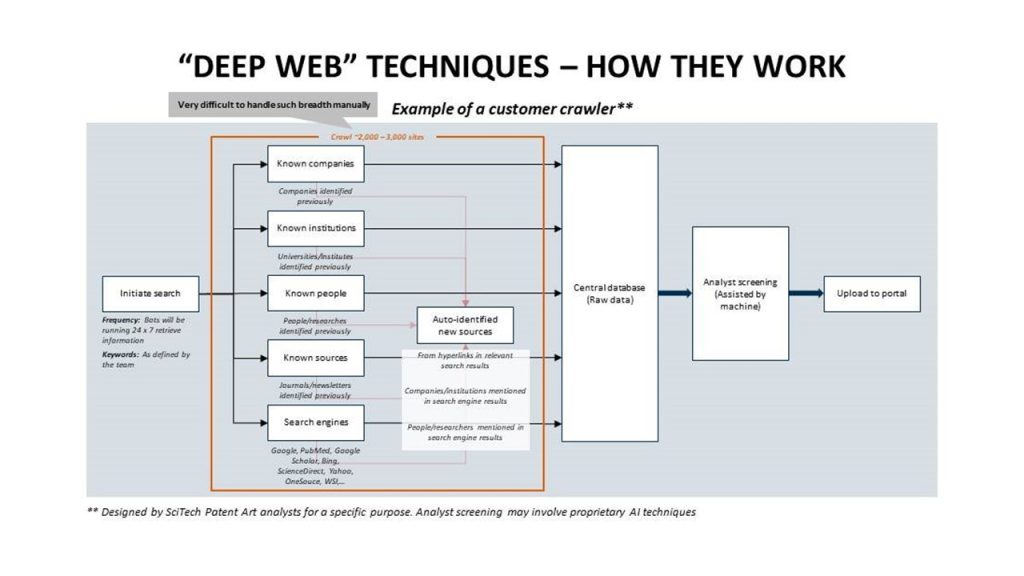
SciTech Patent Art has developed proprietary techniques to simplify non-patent literature search, keeping in mind the challenges associated with NPL searching and the dynamic nature of the web.

Our team of software engineers have developed tools and solutions using their considerable experience in the Intellectual Property (IP) industry, thereby delivering value to technology and innovation research.

SciTech Patent Art has developed a Deep Web search tool as an example of such a solution.

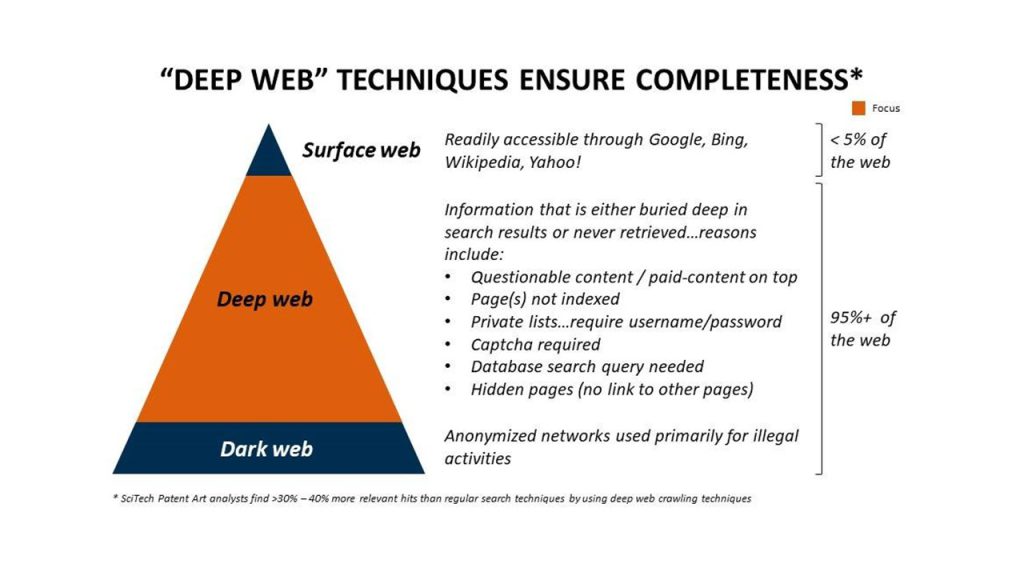
As the name suggests, Deep Web searches refer to searching for information, which is not indexed by public search engines such as Google, Bing, or Yahoo.
Did you know that information that is accessible through such public search engines, which is called “Surface web”, is < 5%?

Contrary to this, the Deep Web search tools, which comprises about 95% of the web, contains information that is either buried deep within search results or cannot be retrieved for the following reasons:

  • Public search engines prioritize content based on geographic location, promotions, etc., which may affect the reliability of the information.
  • There may be some pages that are not indexed due to the owner’s discretion.
  • There are certain websites that are private and require authentication to access.
  • Many other websites require Captchas in order to prevent automated data scraping.

SciTech Patent Art approach to implementing the Deep Web search platform.

The Deep Web search platform built by SciTech Patent Art is a collaborative effort of software engineers, knowledge scientists and search experts at SciTech Patent Art. The team brings technical expertise and domain-specific knowledge to develop an efficient and comprehensive platform for accessing Non-patent literature (NPL) search.

SciTech Patent Art’s Deep Web search platform is built on our strengths:

Domain expertise

– Our team of knowledge scientists curates highly targeted data sources as they have deep knowledge of technologies spanning across chemistry, polymer science, food technology, packaging, mechanical, automotive, medical devices, pharmaceuticals, biotechnology, material science, electrical and electronics, semiconductors, etc.

Search expertise –

Our team of knowledge scientists have many years of experience searching through multiple databases and sources of non-patent literature. They are well-versed in crafting creative search strategies to extract highly relevant art useful for critical search and analytics projects.

Data engineering expertise –

Successful execution of “Deep Web” searches requires core data engineering capability that is offered by our team of software engineers who possess industry knowledge and experience.

Machine learning integration –

Further machine learning-based algorithms are integrated into these domain-specific databases, which adds sophistication to the platform. There are two levels at which machine learning algorithms are developed and integrated:

  • We use machine learning algorithms to develop a comprehensive topic / technology-specific synonym list based on an initial list curated by our team of knowledge scientists.
  • Machine learning algorithms are also used to automate categorization of documents based on the synonym list and contextual information.
Customized data solutions–

The expertise of our team of knowledge scientists and software engineers enables us to develop customized crawlers and scrapers, develop algorithms to structure data, create data pipelines, etc.

Iterative data solutions –

An iterative approach is adopted to ensure that the deep web search platform is routinely refined and updated with the latest data sources, documents, synonyms and technology information.

Deep Web search platforms offer the following advantages:
  • The Deep Web search platform is highly contextual and rich in specific domain / technology, and can, thus, provide insights relevant to specific technologies.
  • A collaborative approach to developing and maintaining this database provides the latest technologies for retrieving and categorizing large data sets.

 Examples of custom NPL searches include – 

  • Analyzing over 5,000 articles in leading medical technology journals to provide a comprehensive understanding of the major problems that researchers are currently working on in a specific technology field.
  • Creating a categorized, in-depth, and comprehensive database by analyzing over 30,000 scientific articles in a specific device technology using advanced data processing techniques.
  • Identifying specific groups of researchers, start-ups, or universities working on a particular technology across multiple regions by accessing various databases and resources.
  • Conducting a big data analysis on a database of 5,000 projects with multiple dimensions to identify specific trends and insights.

Unlock the power of non-patent literature! Discover scientific advancements & industry trends beyond patents. Gain insights not found in patents. Find technical reports, research papers, & more for comprehensive research & informed decision-making.

Non-Patent Literature Search FAQs

1. What is non-patent literature?

Non-patent literature (NPL) refers to any published information that is not a patent document — including scientific journal articles, technical reports, conference proceedings, product manuals, clinical trial data, and regulatory documents. NPL is a critical source of prior art because it often captures technology developments that never entered the formal patent system. For patentability, invalidity, and freedom-to-operate searches, NPL can be just as decisive as patent documents themselves.

2. What is a non-patent literature search?

A non-patent literature search is a structured investigation across scientific, technical, and industry publications to identify information relevant to a specific technology, invention, or patent claim — going beyond what patent databases alone can provide. Because NPL sources are fragmented across thousands of journals, databases, and repositories, a thorough search requires specialized tools that standard search engines cannot replicate. SciTech Patent Art’s proprietary Deep Web platform is purpose-built to access both indexed and unindexed NPL sources comprehensively.

3. Why is non-patent literature important in patent searches?

Non-patent literature captures a large portion of the world’s technical knowledge that never appears in patent filings — particularly in fast-moving fields like biotechnology, pharmaceuticals, and electronics where research is published in journals before a patent is filed. In invalidity searches, NPL is often where the most compelling prior art is found, precisely because patent examiners may not have searched it thoroughly during prosecution. Overlooking NPL means leaving a significant portion of the prior art landscape unexamined.

4. What are the main non-patent literature search databases?

Key NPL search databases include PubMed, IEEE Xplore, Scopus, Web of Science, Embase, Google Scholar, and SpringerLink, alongside specialized repositories for standards documents, clinical trials, and regulatory filings. No single database covers the full range of NPL sources, which is why a comprehensive search must draw from multiple databases and deep web sources not indexed by public search engines. SciTech Patent Art curates domain-specific NPL source lists tailored to each technology area and project requirement.

5. How is a non-patent literature search different from a patent search?

A patent search works within well-structured, globally indexed databases where documents follow standardized formats and classification systems, making searches relatively systematic. A non-patent literature search must navigate thousands of fragmented, unstructured sources — journals, conference proceedings, product specifications, and deep web repositories — each with its own access requirements. This fragmentation is what makes NPL searching significantly more complex and time-intensive, requiring specialized tools and domain expertise for thorough results.

6. What types of projects benefit most from an NPL search?

NPL searches add the most value in patentability assessments, invalidity searches, freedom-to-operate studies, technology landscaping, and competitive intelligence projects where understanding the full technical knowledge base is critical. Industries with strong academic research traditions — pharmaceuticals, biotechnology, medical devices, and advanced materials — benefit most because a significant share of their prior art lives in journals and conference papers rather than patents. SciTech Patent Art has conducted NPL searches across all of these domains using its Deep Web platform.

7. What is a prior art search of non-patent literature?

A prior art search of non-patent literature targets scientific articles, technical papers, and product documentation to identify disclosures that predate a patent’s priority date and could affect its novelty or inventive step. This type of search is routinely conducted during patentability assessments, invalidity challenges, and IPR proceedings where NPL prior art can be just as impactful as a prior patent. SciTech Patent Art combines expert search strategies with AI-powered deep web tools to identify the most relevant NPL prior art for each specific claim.

8. What is deep web search in the context of NPL research?

The deep web refers to roughly 95% of internet content not indexed by public search engines — including paywalled journals, private databases, and authentication-required repositories that a conventional search would miss entirely. SciTech Patent Art has developed a proprietary Deep Web search platform using custom crawlers, machine learning algorithms, and domain-specific data pipelines to retrieve relevant NPL from these hidden sources. This capability is a key differentiator in delivering comprehensive NPL search results that surface-web tools simply cannot match.

9. How does SciTech Patent Art conduct an NPL search?

SciTech Patent Art’s NPL search combines conventional techniques — keyword searches, citation searches, author and institution searches — with proprietary Deep Web tools that access sources beyond what public search engines index. Domain knowledge scientists curate technology-specific source lists, while machine learning algorithms generate synonym lists and automate document categorization for precision and scale. The result is an iterative, contextually rich search that surfaces relevant NPL from both indexed databases and deep web repositories.

10. What challenges make non-patent literature searching difficult?

The primary challenges in NPL searching are source fragmentation, incomplete indexing, and sheer volume — there is no single comprehensive NPL database the way there is for patents, so researchers must search dozens of sources individually. Deep web content, which accounts for the vast majority of online information, is inaccessible to standard search engines, meaning critical technical content is routinely missed without specialized tools. SciTech Patent Art has developed proprietary crawlers, machine learning categorization, and customized data pipelines specifically to overcome these challenges.

11. How is NPL used in patent invalidity and validity searches?

In invalidity searches, non-patent literature is searched to find technical disclosures — journal articles, conference papers, product manuals — that predate a patent’s priority date and demonstrate the claimed invention lacked novelty or inventive step. In validity searches, NPL coverage helps confirm whether the patent’s claims are genuinely defensible against the full body of published technical knowledge, not just the patent record. SciTech Patent Art integrates NPL search as a core component of both invalidity and validity engagements.

12. Can NPL searches support technology and competitive intelligence projects?

Yes — beyond patent-specific work, NPL searches are a powerful tool for mapping the technology landscape, tracking competitor R&D activity, identifying emerging research trends, and spotting potential partners, collaborators, or key researchers in a specific domain. Academic publications, conference proceedings, and technical reports often reveal strategic directions months or years before they surface in patent filings. SciTech Patent Art’s Deep Web platform is designed to support both IP-focused and broader technology intelligence mandates.

13. What industries does SciTech Patent Art cover in NPL searches?

SciTech Patent Art’s knowledge scientists have deep domain expertise spanning chemistry, polymer science, food technology, packaging, mechanical engineering, automotive, medical devices, pharmaceuticals, biotechnology, material science, electrical and electronics, and semiconductors. This cross-industry breadth means the NPL source lists and search strategies are genuinely tailored to each technology area rather than relying on generic database queries. Clients across all these sectors rely on SciTech Patent Art for NPL searches that surface technically precise, highly relevant results.

14. How are NPL search results delivered?

NPL search results are delivered in structured reports that include the search methodology, sources and databases covered, a categorized summary of relevant references, and technical commentary from our domain experts on the significance of each finding. For larger projects — such as analyses of thousands of scientific articles — results may also include categorized databases, trend summaries, and visualizations that support R&D decision-making. SciTech Patent Art tailors the report format to each client’s specific research or legal use case.

Sectors

Subject Matter Expertise

Biotechnology & Pharmaceuticals
Chemical Industry
Chemical Industry
Consumer Products
Consumer Products
Electronics & Telecommunications
Food Technology
Food Technology
Materials Science
Materials Science
Mechanical Equipment
Medical Devices
Medical Devices
Oil & Gas
Oil & Gas
Packaging & Design
Packaging & Design
Searches you can rely on

We deliver high-quality, and tailored searches. We consistently uncover invalidating art for tough claims, which speaks to our search rigor.

  • Database Access

    With over 22 years of experience, we excel in searching industry-leading patent, chemical structure, technical literature, and business databases.

  • Subject matter expertise

    Backed by 20+ years of expertise across fields like chemicals, electronics, and pharmaceuticals, our team delivers unmatched, high-impact results.

  • Deep Web Research

    Our unrivaled deep web crawling sets us apart—our expert data engineers work with subject specialists to uncover and access critical, targeted information.

  • Discovery Partner

    Through close collaboration with clients, often litigating attorneys, our searchers uncover invalidating references, making us a trusted discovery partner—delivering value far beyond typical search firms.

Give us a try. Let’s get started

our approach

How we meet your need

  • your-request

    Your Request

    • Question you are trying to answer
    • Type of search or analysis
    • Turnaround time and budget constraints, if any

  • Scope-and-timing

    Scope & Timing

    • Our proposal
    • Scope understanding
    • Search / analysis strategies
    • Examples
    • Cost and turnaround

  • Results-and-dicussion

    Results & Discussion

    • Preliminary results
    • Scope adjustments, if any
    • Discussion & iteration
    • Final report timing

  • Final-report

    Final Report

    • Final report with conclusions
    • Invoice submitted

Case Studies